
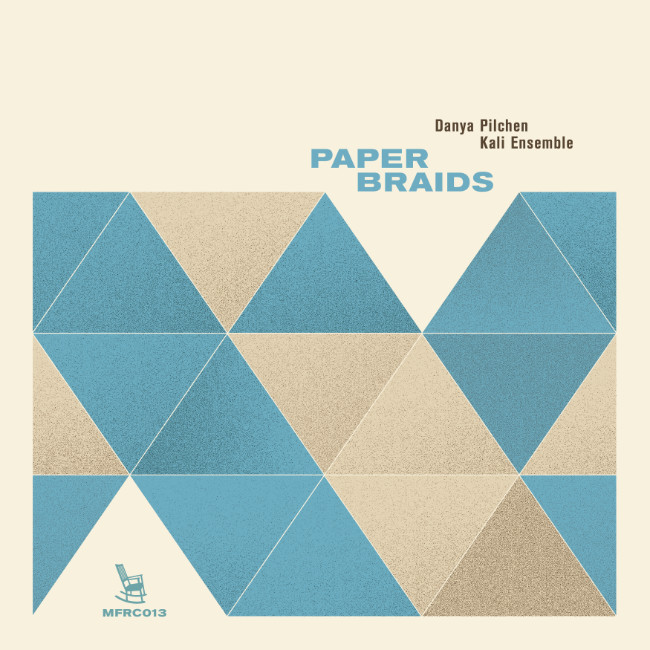
- Danya Pilchen, Kali Ensemble
- Paper Braids
- Series: Contemporary Series
- Format: Cd
- Danya Pilchen
- &
- Kali Ensemble
- Paper Braids
- Series: Contemporary Series
- Format: Cd
Paper Braids came out of a long collaboration between me and the wonderful musicians of the Kali Ensemble. Through a series of workshops, residencies, and performances over the course of four years, we built up a collective practice focused on three topics: listening as the basis of musical interaction, awareness of how sound interacts with the performance space, and using that spatial awareness as a basis for both the duration of individual sounds and the temporal unfolding of an entire piece.
All three focal points of our practice are represented in this piece. Paper Braids is tailored specifically to the acoustics of the Orgelpark hall and the tuning and timbral specificities of the four organs I used: Utopa and Sauer controlled algorithmically via the Hyperorgan console, the romantic Verschueren, and the meantone Van Straten organ. At the same time, the speakers and microphones are placed at four different spots in the hall to induce acoustic feedback in response to the organ sound.
The idea of feedback is a core structural principle of the piece: not only is acoustic feedback responding to the sounds of the organs, but so is the listening of the musicians to the sound in space is guiding their performance: their scores look like ‘maps’ of the sounds in space, and they orient and build their own trajectories based on the sounds they hear. Simultaneously, the algorithm controlling the Hyperorgan reacts to certain sounds as they occur in the space, triggering different events on the organs in turn.
— Danya Pilchen
Reviews
Louder Than War, Richard James Foster
Ukrainian composer Danya Pilchen & Kali Ensemble investigate organ feedback on this uncompromising album full of avant-garde spacewards sound.
You put the record on and nothing happens – until a long, high tone suddenly makes itself manifest after a few minutes and gradually builds in timbre. Other single tones seem to join it, and a sort of baton race emerges between various tones.
After about five minutes these small, incremental processes merge into a shifting sinew of high processed sound that has a more tangible outline. Tones gently sway in and out of harmony and form new sonic alliances as various other component parts are added.
So begins Danya Pilchen & Kali Ensemble’s Paper Braids, the result of four years of collaborative work in The Netherlands. During this time, the young Ukrainian musician and the Hague-based music collective worked to a number of principles around the “act” of listening. The key one for those listening in here may be how we hear sound interacting with a performance space, and how that particular space can “control” how long an individual sound can last, or can manifest, during the lifetime of the music.
The recording was made at Amsterdam’s famous Orgelpark Hall with the acoustics of the Hall in mind, along with the tuning and timbral specificities of the four organs found in the piece. Each has a wonderful name – Utopa, Sauer, Verschueren and Van Straten – and tones to match. Speakers and microphones were placed at four different spots in the hall to milk the acoustic feedback that responded to the organs’ sound.
Danya Pilchen seems to have a specific interest in manipulating feedback in a physical space. I’ve seen his work in action, in a gallery space in Rotterdam, where approaching one of his installations triggered an electronic noise. With Paper Braids, the sound has – obviously – been repackaged as a recording, to be heard in various formats. (More braids in this metaphorical paper chain.) This means the act of listening is different, maybe more difficult in more passive situations where headphones, or the record needle, acts as the midwife.
And I will tell you now, it’s not an easy listen if you’re new to music like this. You may think, once you take the plunge, that I am essentially writing about a long, initially high pitched whine, processed organ notes, and passages of manipulated feedback that lasts nearly fifty (yes, 50) minutes. Those who expect a comparison will have to take my gambit that this music, with its extended tones and experimental or “antiformal” approach to composition, lies broadly in the tradition of La Monte Young, Tony Conrad, and the minimalists, or maybe the Hague School and even Paul Panhuysen in the manner of, or the ideas around, its construction. For those curious to suck all this stuff and see, we can only echo Viv Savage at the back of the tour bus: there are whole new worlds out there.
Listen in closely and some really transcendent passages make themselves manifest. Around the twenty three minutes mark, the differences in the organ parts become clearer, with more resonant tones establishing themselves. Again, for those wishing a comparison, imagine a stripped-back Tim Hecker. We drop to ghostly mid-tone which ushers in a slightly atonal thrum that has something cosmic about it: part Protestant organ service, part Tardis taking off. Deeper, more resonant tones start to build and fan out, inhabiting a wider sonic space. At this point, things get very kosmische: Klaus Schultze’s Cyborg or Irrlicht could come to mind. From this heady point, things gradually dissolve into a long passage of deep, prenatal throbs of various weights. These eventually evaporate, and resolve around an ending that sounds like a huge old wind turbine starting up. The mellow ending comes as a shock. By the record’s end, you can feel quite out of puff.
This is an intense, sometimes spiritual listen and my best advice is to surrender to the sound in all its varying iterations. Give it a go.
More about Danya Pilchen can be found here. Danya Pilchen’s site is here. Kali Ensemble’s site is here.
All words by Richard Foster. More writing by Richard can be found at his author’s archive.
Igloo Magazine, Philipp Blache
A slow-burning meditation on the inner life of sound, Paper Braids unfolds as a meticulous exploration of space, microtonal nuance, and the fragile poetry of sustained tone.
Microtones in breathing space
Netherlands-based Moving Furniture Records can be considered among the finest promoters of multi-perspective experimental contemporary music and electronic sound art, with a particular interest in elementary interactions with space as part of the acoustic phenomenon. Notorious conceptual artists and projects in the field have released material through the label, including Bruno Duplant, Gareth Davis, Alvin Curran, and Annea Lockwood.
Paper Braids is the result of a longstanding artistic dialogue between composer Danya Pilchen and the Kali Ensemble. Based in The Hague, Danya Pilchen is a Ukrainian composer, pianist, and sound explorer with a strong interest in the sonic range of tones, modulated sine waves, and dynamic spatial environments. The outcome is as intuitively poetic as it is conceptual.
The album is demanding in terms of listening disposition and the ability to lose oneself in subtle sonic gestures and slowly evolving tones. From my perspective, it continues the stylistic path and formal experimentation explored by Eliane Radigue in her work on silence and nearly imperceptible yet mutable micro-frequencies—questioning the “inner life” of sound itself.
The main instrument here is the pipe organ, approached through a minimalist practice centered on micro-improvisations, attentiveness to sound ecology, and gradual mutations of the signal. Paper Braids ultimately functions as a cerebral and meditative sound event—an invitation to deeper investigation into interiority, spectrality, and space. Everything lies in the details, requiring from the listener a high level of focus and immersion. Yet for all the attention it demands, the album remains an insightful musical exploration—at once radical and beautiful.
It is highly recommended for those drawn to distinctive explorations of sound continuum, microtonality, and brainy, meditative soundscapes, such as the “modern times” electroacoustic research of INA-GRM, as well as works by Alvin Lucier, Drew McDowall, Felicia Sjörgen, Charlemagne Palestine, and Eliane Radigue, along with select releases from the label’s own catalog.
Felthat Reviews
Paper Braids is an upcoming album which is a collaborative work of Kali Ensemble from Hague and an Ukrainian composer Danya Pilchen.
A great work which makes you ponder on how the musical practice and composition can exist in specific spaces and specific conditions that have unique acoustic features and help to emphasize certain aspects of compositional energy used by the person who created the compositions to the wider extent of the space used by the ensemble.
When it comes to musical geography – it would be fair to say that the material released by Moving Furniture has different aspects of modern composition and minimalism but also other elements.
But the main actress, the main protagonist of this album is the live interaction between musicians and their instruments. A certain form of synchronicity and guided commotion that livens up the composition wouldn’t be possible if it wasn’t for the awareness that the musicians have – their conscious move towards working together and encapsulating it into one unit.
It has worked beautifully and proved the point of how diverse can the musical conversation be.