


- Gareth Davis
- &
- Scanner
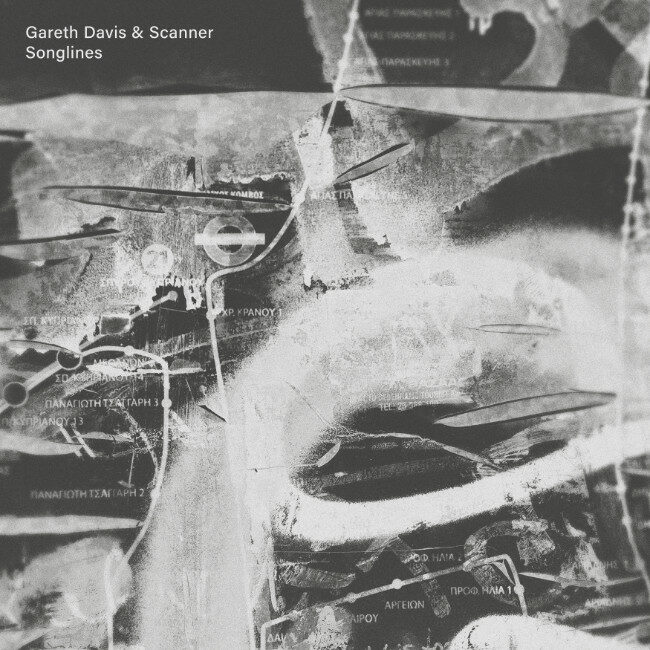
- Songlines
- Series: Moving Furniture Records
- Format: Vinyl
- Gareth Davis
- &
- Scanner
- Songlines
- Series: Moving Furniture Records
- Format: Vinyl
When the ghost in the machine meets the breath in the reed, expect sparks. Electronic sound artist Robin Rimbaud – Scanner joins forces with acclaimed British bass clarinetist Gareth Davis to create an album where circuitry hums, wood vibrates, and the air between notes crackles with possibility.
This is no polite meeting of minds — it’s an elegant collision. Scanner’s intricate electronic textures weave around Davis’s deep, resonant tones, blurring the boundary between acoustic breath and digital pulse. The result is a sound world that’s at once intimate and expansive, familiar yet thrillingly unpredictable.
Think late-night conversations in abandoned buildings. Think fog rolling over neon. Think sound that slips through your fingers even as it takes hold of you.
The songlines in question , memories and distorted images of travels across various continents, form an imagined biography of places that might or might not have been but somehow seem to exist . Landscapes of blurred statements , lost words and echoes of meandering structures.
“If Miles Davis had been raised on shortwave radio static and midnight phone calls, it might have sounded like this.”
Reviews
From the family of wind instruments, I like the clarinet the best. I couldn’t say why this is; I guess it boils down to personal taste. Gareth Davis is a bass clarinettist from the UK, living in the Netherlands, who collaborates with musicians from diverse backgrounds, ranging from free improvisation to noise and electronics, as this album demonstrates, having recorded with Robin Rimbaud, also known as Scanner, for over 30 years. Initially using sounds scanned from the (police radio) waves, he is long beyond the found sound approach and using a brand of modular electronics. There’s no information available about how the two musicians created this album, being together in the studio or exchanging sound files via the Internet. I gather it’s the latter, but I have no evidence to back this statement up. This lack of knowledge is quite annoying, as the album is excellent and I’d love to know more. The bass clarinet is an instrument I hardly recognised in the music. Maybe it is so deep that it hovers in the lower end of the music, looped around, and is fed to the electronic circuit boards of Scanner, adding a brand of electronics in the higher range. In ‘Structure Of Statements’, on the first side, this leads up to a very cosmic tonal quality halfway through the piece, and the bass clarinet adds delicate chopped tones to the arpeggio electronics, with drones below to keep the piece afloat.
On the other side, we find ‘Figurative Language’, in which some found sounds are used (not entirely forgotten), along with some kind of field recordings, and slow-motion waves, pumping in and out, slowly building until the two decide to take down the affair and start a drone-like quietness, seemingly into the descent, with some rattling percussive sounds, along a neat bouncing synthesiser sound. Quiet but full of tension, which is something that can be said of the entire record; underneath all the delicacy, there’s a lot of hidden tension, dark and atmospheric, like danger that could erupt at any point, but it never does.
AmbientBlog, Peter van Cooten
Within two months after the release of Forces, Reactions, Deflections, another Scanner album sees the light of day. The Dutch Moving Furniture label releases Songlines – Rimbaud’s collaboration with bass clarinettist Gareth Davis.
The sound on the two (18-minute) tracks, called ‘Structure Of Statements’ and ‘Figurative Language’, is somewhat lighter (in the sense of ‘less heavy’) than that on Forces …
The duo takes their time to develop the tracks, combining drones with loops, creating ‘an album where circuitry hums, wood vibrates, and the air between the notes crackles with possibility’.
Gareth Davis way of playing his bass clarinet is usually easily recognisable, so it surprised me that that specific, very personal sound seems absent in these recordings, ór it is buried very deep in the mix. Davis is also credited for effects, so maybe his clarinet parts are heavily treated and altered to merge into Scanner‘s electronic textures. The same applies to the clarinet played by Monika Bugajny, who joins the duo in this recording: it’s there, somewhere, but hard to distinguish.
“Think late-night conversations in abandoned buildings. Think fog rolling over neon. Think sound that slips through your fingers even as it takes hold of you.”
Songlines is available on vinyl and digital. Official release date is November 21, but the album can already be pre-ordered.
Magazine Sixty Music, Greg Fenton
When one door closes, another door opens. It’s the feeling of freedom that welcomes you into this seemingly infinite exercise in notation that is so liberating, not bound to any specific predefined structure other than a communication of electrical impulses and seismic instrumentation. A world to get lost in and rediscover.
Driven not by softness or delicacy, but by a strong, solid ambience that surrounds you with thoughts of language and imaginary scenarios unfolding as the music plays. This reflects the intense intimacy and excellence sound can attain when it is provocative and sincere. Structures Of Statements begins with a journey lasting seventeen captivating minutes, gradually shifting into a series of gentler pulses, while contrasting emotions suggest wonder and light emerging from the darkness. Like the sun breaking over the morning horizon.
Figurative Language feels more intense without the filtered optimism but remains deliriously powerful, full of a world of expressionist poise and signature drama. Two preview versions follow, with ‘Structure Of Statements’, offering the previous light and shade in short form, containing the ember of a strained whisper haunting through the veil of hypnotic arpeggios. Songlines then departs, leaving the blistering drones and found sounds of Figurative Language’s preview to encapsulate darkening tomorrows in its wake.
Exit stage left.
Recent Music Heroes
Translation:
Gareth Davis and Robin Rimbaud’s 2-track taies search, notice and store silence in sounds. How to match the invisible in the present so that it becomes visible? Their interaction, analysis and presentation of perspective takes place at the intersection of midpoint and post-rock music. This is not a playing field for fine and raw combat; raw is left aside from the formula — it is not based on opposition and exclusion; instead, there is a gradual ascension in which both (false) guitars (despite the obvious sound, there are no guitars here), electronics and real-sound manipulation play an equal role. Electronics, in turn, can also mean guitars, but the sounds of (guitars) have been processed in such a way that they do not act as a source of rock musical connections. By castrating images of rock music with stadium cravings, an outlet is given to those tensions that are considered indecently experimental there (without even letting these nightmares arise). The continuity of the tandem thought has transformed into a midient background, part of which is either the alternation of fractal layers or the tension and loosening of sound tissue. During these 46 minutes, midpoint music provides a permanent tonal, textural and suggestive basis – analogous thought – that allows the listener’s mind to follow the overall direction without being distracted by sharp and broken signs. Considering the fact that Robin Rimbaud is a big fan of Swans, for example the song “Figurative Language” the hypnotic stepping of the other side probably indicates taking schnitti. There are not many all kinds of references and interruptions, but in the light of the aforementioned background, they seem relatively tectonic. Sound vibrates, being amplified and charged. However, we cannot find such a charge in established rock and pop music. However, it resonates with rock music as a different and rebellious (original) idea image. 8.0