


- Bruno Duplant, Judith Wegmann
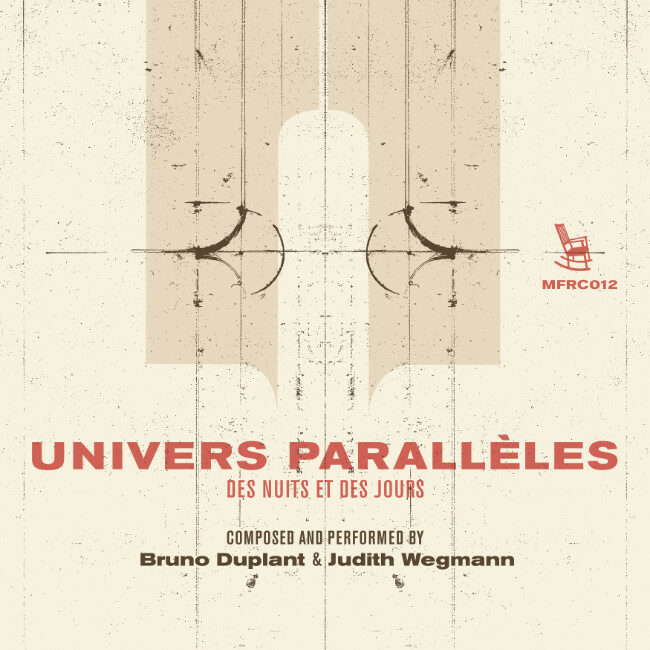
- Univers Parallèles - Des Nuits Et Des Jours
- Series: Contemporary Series
- Format: Cd
- Bruno Duplant
- &
- Judith Wegmann
- Univers Parallèles - Des Nuits Et Des Jours
- Series: Contemporary Series
- Format: Cd
“The line is a whole, an identity, for a particular place and time.” —Fred Sandback The room is defined by stark white walls, with the ceiling and floor crafted from concrete — its grey hue resembling the mist of fog. Sunlight floods the space through large windows on one side, illuminating the hall’s expansive volume, which is interrupted by a solitary wall bisecting the area. Within this space, drawings appear — crafted in the air itself, forms suspended as volumes of aether. Geometric shapes, pristine and untouched, manifest in the emptiness between surfaces. As one moves through the room, the act of walking becomes a meditation on perspective. It is as though the mind is unmoored, unable to retain its grasp on stable concepts. The realization there is only a certain amount of control one can have over a situation. Thin threads of knitting yarn — delicate, taut, and almost fragile — stretch across the room, demarcating zones, parallelograms, triangles, quadrants. They hold barely together, as if on the verge of disintegration. These threads exist in the precise moment before the dissolution of form; a point where all ideas inevitably unravel. There is an assertion of space here, of volume and place, yet without possession. The space is neither claimed nor concealed.
It simply is — existing and non-existing at once. The boundaries of shape and dimension blur, becoming ambiguous and transient. Being in a place and being a place, simultaneously. The universe is not a distillation. It is not a reflection of anything beyond itself. It simply is — pure fact, without reference or hierarchy. No instance of a system or order larger than itself. Except, perhaps, the existence of a parallel. Here and now, space and time are contained within sound, drawing itself into existence. Occam’s razor eliminates everything that is not line, cutting through the white cube as though emerging from an a priori ephemeral, shifting diffusion of perceptual poetry.
— Sven Schlijper-Karssenberg
Reviews
Vital Weekly, Frans de Waard
Some time ago, it seemed I reviewed a new CD by Bruno Duplant every week, but as these things go, it went quiet. Very few people can hold up crazy release schedules. I wrote many times before that I have no idea how Duplant works, with instruments and electronics, but Luc Ferrari’s work is a primary inspiration. On this new CD, he works with Swiss pianist Judith Wegmann. I didn’t know her. She studied jazz and classical music and plays jazz, contemporary and improvised music. She performs works by Stockhausen, Feldman and Cage. About the work she recorded with Duplant, we aren’t told a lot, so, with some reservation, I’d say the start is a piano improvisation by Wegmann and Duplant takes things down a slightly different path. He leaves the original piano part intact and adds music of his own. Perhaps one aspect of Duplant’s additions involves processing the piano sounds, along with other additional sounds. At various points, there’s a particularly high-pitched sound, which probably sounds even meaner to younger people (having better hearing than this older man). There’s also something that reminded me of processed percussion, field recordings from around the house (electrical currents, household equipment and such like), but also drones. In general, Duplant adds a wealth of obscure sounds to the tranquil piano playing of Wegmann. She plays quietly, sometimes even almost disappears in the mix, but always returns. Her playing is open, with gestures here and there, very much in the field of contemporary music. Yet the music doesn’t feel like new classical music (despite being part of Moving Furniture’s Contemporary Series), and that’s due to Duplant’s additions, which are all over the place, sometimes seemingly incoherent. Still, it’s that relatively free approach, bringing it more into Duplant-land, that makes me enjoy this release a lot.